Flutter Web: Best Practices & Ideal Project Scenarios
November 8, 2023 — 10 min read

Unlocking Flutter Web’s potential: a comprehensive guide to best practices, project suitability, and strategies for crafting standout web applications.
Flutter, created by Google, has changed the way we think about app development. At first, it was all about making mobile apps — one set of code could work on many devices. But Flutter didn’t stop there.
Flutter has already made its mark in the world of web development. Developers have the capability to craft websites with Flutter that are both visually appealing and efficient. The highlight? They achieve this using the Flutter tools with which they’re already familiar.
In this guide, we’ll take a closer look at how Flutter is making waves on the web. We’ll explore its features, the challenges, and why it’s becoming a top choice for web developers everywhere.
Moving from mobile to web development might seem like a big step. But with Flutter, it feels more like a small step. Why? Because a lot of what you know from using Flutter for mobile still applies. The foundation, like the Dart language and the way you use widgets, stays the same.
But, there are some new things to think about. On mobile, you’re usually designing for a few standard screen sizes. On the web, it’s a different game. Websites need to look good on everything, from a tiny phone screen to a big desktop monitor. This is where the idea of responsiveness comes in. It means making sure your website adjusts and looks great no matter the screen size.
Flutter offers tools to help with this. But, like anything new, there can be challenges. Different web browsers might show your site a bit differently. So, it’s important to check and make sure everything works smoothly across the board.
In this section, we’ll dive deeper into the journey of using Flutter for the web and share some tips to make the transition smoother.
Flutter, an open-source technology backed by Google, has been a game-changer in the app development landscape. Initially recognized for mobile app development, its journey into web development has been transformative, challenging the native vs. cross-platform debate.
Flutter has consistently stood out in the cross-platform development realm. Its unique proposition of a unified codebase for diverse platforms, including Android, iOS, and the web, has been a game-changer. From its inception to 2021, Flutter’s adoption among cross-platform developers witnessed a significant rise from 30% to 46%. With the insights from 2023, it’s evident that Flutter’s popularity is not just a fleeting trend. Its adoption rate is poised to climb even higher, especially with the innovations brought by Flutter 3. Major industry players like eBay and Alibaba Group have already embraced Flutter, underscoring its potential and reliability in the app development world.
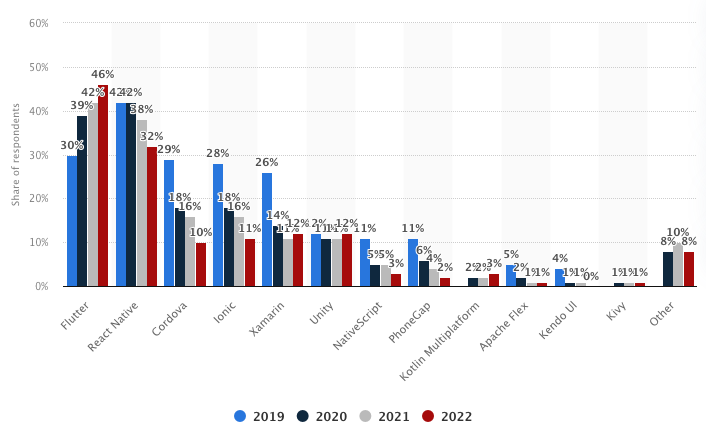
A standout feature of Flutter is its impeccable performance and stability. Apps developed with Flutter often outperform those made with other cross-platform frameworks in terms of speed, responsiveness, and resource utilization.
Flutter’s versatility is evident in its support for both mobile and desktop platforms. While it was already a robust framework for iOS and Android, it has supported Web since 2.0 release and the latest version extends its capabilities to desktop platforms like Windows, Linux, and macOS. This means applications can now be developed for all these platforms from a single codebase, leading to significant time and cost savings.
Flutter’s versatility shines through its expansive support for various platforms. Initially a robust framework for iOS and Android, its capabilities were further broadened with the release of Flutter 3 on 11th May 2022. This update enabled developers to craft applications for desktop platforms, specifically Linux and macOS, using the same codebase. Consequently, this evolution allows for substantial time and cost efficiencies, as applications can now cater to mobile and these desktop platforms seamlessly.
Despite being a cross-platform framework, Flutter does not restrict developers from integrating platform-specific features. It offers a plethora of widgets tailored for Android, iOS, Windows, macOS, and Linux. Moreover, it allows third-party integrations and APIs using various programming languages, ensuring that native features can be seamlessly incorporated without compromising performance.
One of the challenges in cross-platform development has been crafting user interfaces that feel native to each platform. Flutter has effectively addressed this challenge, offering tools that allow developers to harness platform-specific features and capabilities. As a result, apps developed with Flutter often “feel like native,” bridging the gap between cross-platform and native development.
At the heart of Flutter’s success is the Dart programming language. Dart, which is client-optimized and object-oriented, has garnered a vast community of enthusiasts over the years. Its simplicity and efficiency, especially for those familiar with Javascript, have played a pivotal role in Flutter’s widespread adoption.
Flutter’s evolution over the past few years underscores its potential and versatility. As it continues to grow and adapt, it offers developers a powerful toolkit to craft efficient, responsive, and visually appealing applications across platforms.
Flutter Web, while revolutionary in bridging the gap between mobile and web applications, does present its set of challenges. Developers venturing into the Flutter Web realm often encounter a spectrum of technical hurdles. Here’s an enumeration of the common challenges:
Code Size Concerns: Flutter Web applications tend to have a larger initial footprint compared to those crafted with conventional web technologies. This can result in extended initial load times, particularly impacting users with limited internet speeds. However, it’s worth noting that after this initial load, Flutter’s performance is on par with other Single Page (SP) applications.
Animation Fluidity: While Flutter is renowned for smooth animations on mobile, replicating the same fluidity on web platforms can sometimes be challenging.
Flutter Web’s nature as a single-page application can pose challenges for search engine optimization. Dynamic content rendering might not always be as SEO-friendly as static content.
Ensuring consistent behavior and appearance across various browsers is crucial. While Flutter Web aims for cross-browser compatibility, discrepancies can arise, especially with less popular or older browsers.
Achieving uniform behavior and appearance across diverse browsers is paramount. Flutter Web, not relying on CSS, often exhibits more consistent behavior across different browsers. However, some variations might still occur, particularly with less mainstream or dated browsers.
The Flutter ecosystem is vast, but not all packages are optimized for web development. Some mobile-centric packages might not function as expected on the web, necessitating workarounds or alternative solutions.
While Flutter Web offers a plethora of advantages, it’s essential for developers to be cognizant of its challenges. By understanding these hurdles and actively seeking solutions, developers can harness the true potential of Flutter Web, crafting applications that are both functional and user-friendly.
Flutter Web is revolutionizing the way developers approach web applications. To make the most of this powerful framework, it’s essential to be equipped with the right tips and best practices. Here’s a guide to help you navigate the intricacies of Flutter Web:
Optimize for Performance:
Design with Responsiveness in Mind:
Maintain UI Consistency:
Stay Updated & Engage with the Community:
Implementing Flutter Web requires a blend of technical know-how and best practices. By focusing on performance, responsiveness, navigation, UI consistency, and testing, developers can craft web applications that stand out in the crowded digital landscape. Stay curious, keep learning, and let your Flutter Web projects shine!
Flutter Web shines in creating interactive portfolios, business websites where a unified codebase with mobile is beneficial. Its widget-based architecture ensures visually appealing and responsive sites. However, for web applications requiring advanced browser functionalities, traditional web frameworks might be more suitable.
While Flutter Web offers a robust platform for web development, like any framework, it’s essential to evaluate its fit based on specific project requirements, especially when dealing with intricate real-time applications or unique browser API integrations. In essence, while Flutter Web is a game-changer for many projects, it’s essential to evaluate its fit based on the project’s complexity and requirements.
During the Flutter Forward event broadcasted from Nairobi, Kenya, the Flutter team unveiled some of their future plans for the framework. These plans encompassed a range of advancements, including:
Flutter Web is making a big splash in the world of web development. Its ability to use one set of code for different platforms, combined with its great design tools, has caught the attention of many developers. But, like all tools, it has its ups and downs. It’s important for developers to know these and stay updated as Flutter keeps changing and getting better. The future looks bright for Flutter with new features and improvements on the horizon. If you’re thinking about web development, now might be a great time to dive into the world of Flutter Web and see what it can offer.

Adrijan, a seasoned Flutter developer at Q agency, balances his tech expertise with a passion for sports during his off-screen moments.
Partner with us